|
| 1 |
In this post, I will touch on the auspicious names given to certain "lucky" plants and their symbolism during Chinese New Year and/or in Chinese culture.
Note: This post has been updated on 8th Feb 2018 with 2 new photos of hyacinths and narcissus which are available here now.
This year's Chinese New Year falls on Friday, 16th February 2018 and during Lap Chun (Lichun) which fell on Sunday, 4th February 2018 at 5:30am local (Malaysia) time, we ushered in the Year of the Earth Dog. (To find out more about Lichun, please click on the highlighted link).
I've been pretty busy lately, so I must admit that I have neglected my blog for quite some time. And how time flies! A year has passed since my last blog post.
Anyway, we have come to the most exciting time of the year for buying plants and flowers. We believe that auspicious plants, flowers and fruits brings good fortune and the adage of "花开富贵" - hua kai fu gui" (Mandarin) or "fa hoi fu gwai" (Cantonese) which literally means that blooming flowers symbolize prosperity.
Nurseries will be filled with lots of interesting festive and seasonal plants. A visit to the nurseries is an exciting event and great learning experience for me. It is also a great opportunity for us to buy new plants, and try growing some seasonal festive, cool climate plants that we have never tried before.
Note: This post has been updated on 8th Feb 2018 with 2 new photos of hyacinths and narcissus which are available here now.
This year's Chinese New Year falls on Friday, 16th February 2018 and during Lap Chun (Lichun) which fell on Sunday, 4th February 2018 at 5:30am local (Malaysia) time, we ushered in the Year of the Earth Dog. (To find out more about Lichun, please click on the highlighted link).
I've been pretty busy lately, so I must admit that I have neglected my blog for quite some time. And how time flies! A year has passed since my last blog post.
Anyway, we have come to the most exciting time of the year for buying plants and flowers. We believe that auspicious plants, flowers and fruits brings good fortune and the adage of "花开富贵" - hua kai fu gui" (Mandarin) or "fa hoi fu gwai" (Cantonese) which literally means that blooming flowers symbolize prosperity.
Nurseries will be filled with lots of interesting festive and seasonal plants. A visit to the nurseries is an exciting event and great learning experience for me. It is also a great opportunity for us to buy new plants, and try growing some seasonal festive, cool climate plants that we have never tried before.
 |
| 2 |
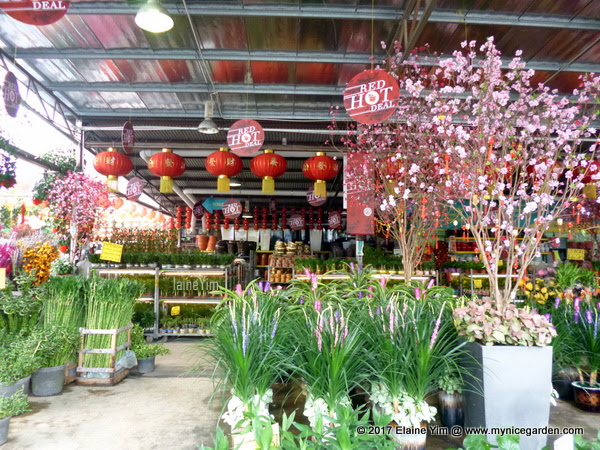
I visited 2 nurseries in Ipoh to find out what plants and flowers are on offer or popular during Chinese New Year 2018, the year of the Earth Dog. As it was the 3rd week of January when I visited, imported cool climate plants such as narcissus, hyacinths, amaryllis, clivias, cymbidiums, peach, plum and peonies were not available yet. These are seasonal plants imported from Holland or China. But, there were already plenty of anthuriums, chrysanthemums, kalanchoes, guzmania, lucky bamboos, pussy willows and orchids. These probably came from Cameron Highlands, Taiwan, Thailand and China.
In Ipoh, there are many plant nurseries in Jalan Kuala Kangsar as well we Ampang area. These 2 nurseries I visited are actually quite near to the city centre.
In Ipoh, there are many plant nurseries in Jalan Kuala Kangsar as well we Ampang area. These 2 nurseries I visited are actually quite near to the city centre.
Let's take a look at Tong Sun Nursery (Facebook click here , website here) and in Jalan Silibin, Ipoh...
 |
| 3 |
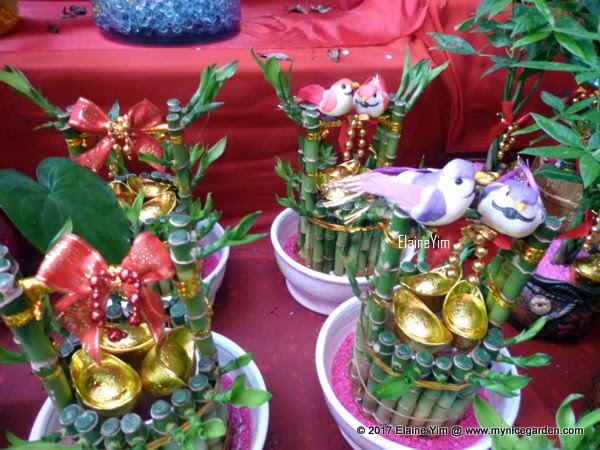
Lucky bamboos are usually the first to appear. Here they are already adorned with auspicious ornaments complete with red ribbons and gold trimmings. Even the flower pots are beautifully decorated with auspicious designs and motifs.
 |
| 4 |
Pussy Willow is called "ngan lau" in Cantonese. It sounds like money and lots of money flowing in. There is a saying, "yau ngan chow yau lau" meaning when you have money, you can buy property.
 |
| 5 |
The doggies take centre stage.
After all, 2018 is the year of the Earth Dog.
 |
| 6 |
Lucky bamboos decorated with wealth god and phoenixes on the left.
Chinese taro (Alocasia cucullata) on the right.
It is "yu tou" in Mandarin and "hao yu tou" signifies good news, good luck or good omen.
 |
| 7 |
 |
| 8 |
Lots of auspicious paraphernalia to choose from. Don't they look like the jewelries we wear for beauty?
Haha, during Chinese New Year, even plants are decorated with bling-bling until they glow, glitter and shimmer! Obviously the most popular colour is red, yellow and gold.
 |
| 9. |
Left: Red leafed Aglaonema aka Chinese Evergreens.
It is known as "hong cai shen (Mandarin): meaning "Red Wealth God"
Right: Crinum asiaticum is known as "fa cai suan". It means that you have lots of money to count!
 |
| 10 |
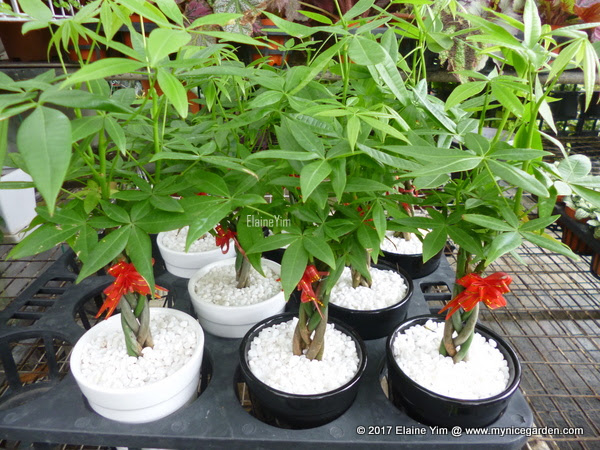
Pachira aquatica is known as the " mei kum shu" in Cantonese meaning the US Dollar Tree.
Its other common names include Money Tree, Fortune Tree, Provision Tree, Malabar Chestnut.
Its other common names include Money Tree, Fortune Tree, Provision Tree, Malabar Chestnut.
 |
| 11. |
Ardisia crenata or Christmas Berry is known as "fu gui zi" meaning rich and honorable with many sons.
 |
| 12. |
Dischidia oiantha is known as "chin tap chin" meaning money $$$ stacked on top of money $$$.
 |
| 13. |
Aphelandra squarosa aka Zebra Plant is "wang choi chau sau" in Cantonese.
It means indirect wealth, other sources of wealth or windfall luck is at hand.
It means indirect wealth, other sources of wealth or windfall luck is at hand.
 |
| 14. |
Pitcher plants or "zhu long cao" with hanging cups to capture and accumulate wealth from different directions.
 |
| 15. |
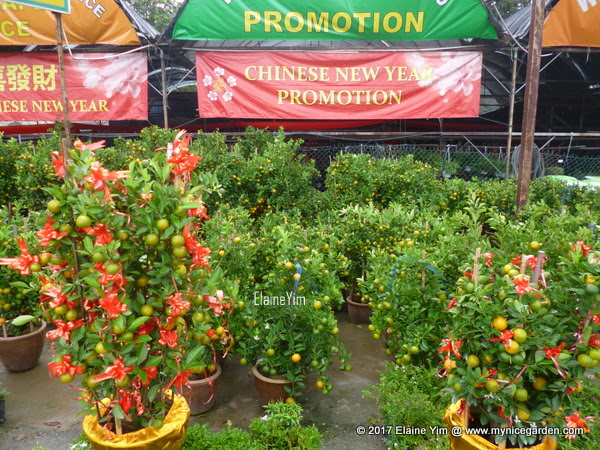
Kumquat trees.
"kum" is gold and "kat" is lucky or auspicious
 |
| 16. |
Four Seasons Lime trees.
 |
| 17. |
Dragon lime. (Loong tam kat)
 |
| 18. |
Schefllera arboricola aka Dwarf Umbrella Tree is known as "qi ye lian" or 7-leafed lotus.
The above is a variegated cultivar.
Not sure why but some buyers search for this plant for fengshui purposes to enhance their zodiac signs after consultation with their feng shui masters.
 |
| 19. |
Dischidia pectinoides is known as Wealth Wallets or Money Pockets
 |
| 20. |
An evergreen tree (Ficus Bonsai - Ficus microcarpa 'Ginseng') shaped into figure of 8.
Evergreen trees are symbols of longevity while the number 8 symbolizes wealth (huat ah!)
and it also looks like the mathematical symbol (lemniscate) of infinity.
Therefore, this arrangement can be positively interpreted as everlasting or infinite wealth and longevity.
Evergreen trees are symbols of longevity while the number 8 symbolizes wealth (huat ah!)
and it also looks like the mathematical symbol (lemniscate) of infinity.
Therefore, this arrangement can be positively interpreted as everlasting or infinite wealth and longevity.
“Chinese New Year 2018 Lucky Plants and Flowers and their Symbolism”, a copyrighted post, was written for My Nice Garden blog by Elaine Yim @ http://www.mynicegarden.com/ on 5th February 2018
The following pictures are from Hock Loke Siew Nursery (Facebook here and website here) in Jalan Chin Choon Sam, Ipoh...
 |
| 21. |
My interpretation :
Lucky bamboos on the left and the US Dollar Tree (Pachira aquatica) on the right. Wealth God is smiling happily and arriving on a merchant ship laden with treasures and gold ingots. He is also carrying a treasure chest. An award winning golden dog with medal around its neck is holding an auspicious banner and it is sitting on a pot of gold.
Notice the little red lanterns, red ribbons, fire crackers, birds (phoenix) and the golden tangerine (kat)?
 |
| 22. |
The two little tuffs of grass-like plant on the bottom left and right corner is the Miniature Sweet Flag (Acorus gramineus) which is known as "jin gian pu" in Mandarin.. It sounds like treasure chest of gold and money. This one has 2 "cai shen" wealth gods and a pair of laughing buddhas.
Notice the overflowing gold from the purple plants just below the US$ tree?
Can you find the pair of golden doggies?
Notice the overflowing gold from the purple plants just below the US$ tree?
Can you find the pair of golden doggies?
 |
| 23. |
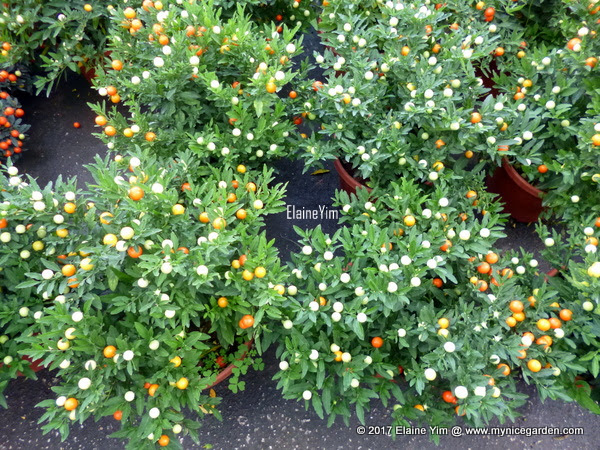
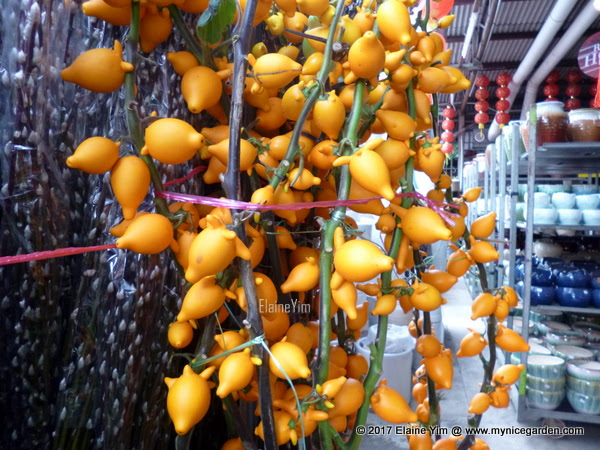
Solanum mammosum represents 五代同堂 - wu dai tong tang, meaning "five generations living harmoniously or gathered together under one roof". According to traditional beliefs, it is regarded as a great blessing for the patriach/matriach when there are grandchildren, great grandchildren, and offspring of numerous generations gathered for a family reunion.
 |
| 24. |
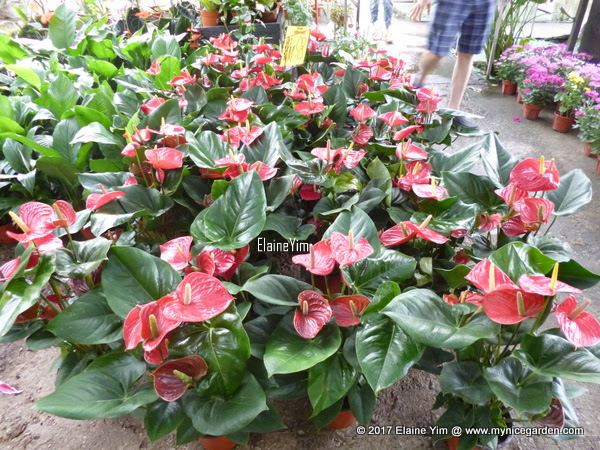
Red poinsettias, anthuriums and rose begonias.
Red represents celebration and prosperity.
Red represents celebration and prosperity.
 |
| 25. |
Red leaf Aglaonema, the Red Wealth God
 |
| 26 |
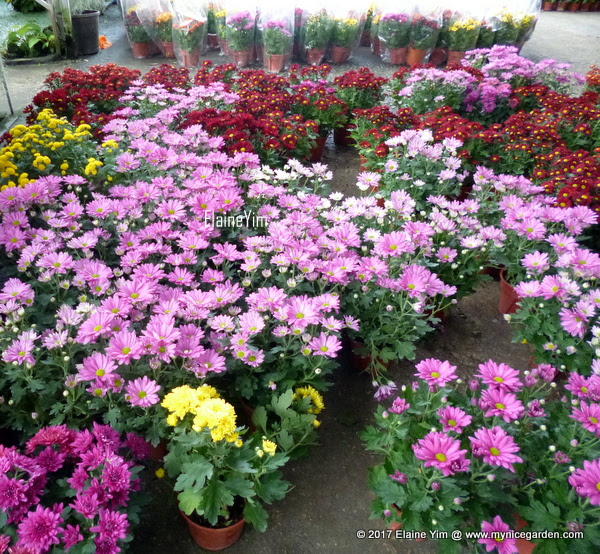
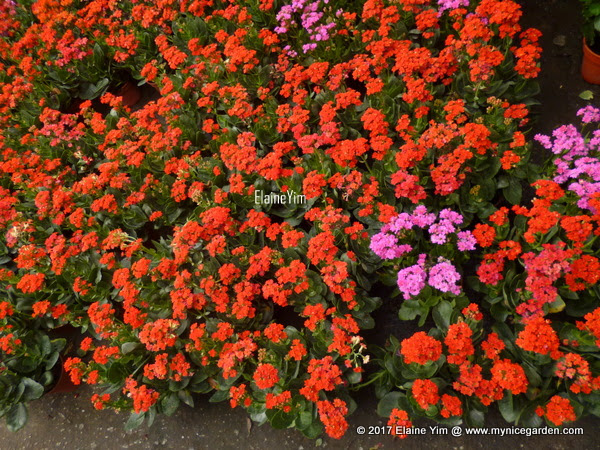
Chrysanthemums, kalanchoes, gerbera daisies, guzmanias in auspicious colours of gold, orange, yellow, purple and red.
 |
| 27. |
Phalaenopsis orchids aka moth orchids.
These gorgeous orchids last a long time.
The flowers look like butterflies.
 |
| 28 |
Even the flower pots are in auspicious colours of red and gold with cherry blossoms motifs.
 |
| 29. Hyacinths (New Update) |
Updated on 8th February 2018:
The hyacinths and narcissus have arrived in Malaysia. You can get them at nurseries and florist shops now. The additional 2 photos are provided by Tong Sun Nursery in Ipoh.
For those staying in Klang Valley, you can get hyacinths and narcissus at Lot 61, Selangor Green Lane or florists in KL Chinatown (Petaling Street) such as Lee Wah Florist and Weng Hoa. Lee Wah Florists has peonies, tulips and hydrangeas as cut flowers.
 |
| 30. Narcissus |
WISHING YOU A HAPPY & PROSPEROUS
CHINESE NEW YEAR 2018,
YEAR OF THE EARTH DOG!